
Research Accepted talk · computational study

Thermoelectric-Assisted Amine Regeneration for Cookstove Pollution Capture

A computational study of whether a thermoelectric generator can regenerate aldehyde-capturing sorbents. The sorbent captured well, but the generator couldn’t supply enough heat to regenerate it.

  • Role: Lead Author (2026 study); Sole Author (2025 preprint)
  • Mentor: Rishabh Jitender, Georgia Institute of Technology
  • When: Oct 2024 – present
  • Time: 2–4 hours a week, 20 weeks a year
  • Status: Computational study. Accepted MIT URTC lightning talk, 2026
PythonNumerical modelingCOMSOL Multiphysics (2025 model)
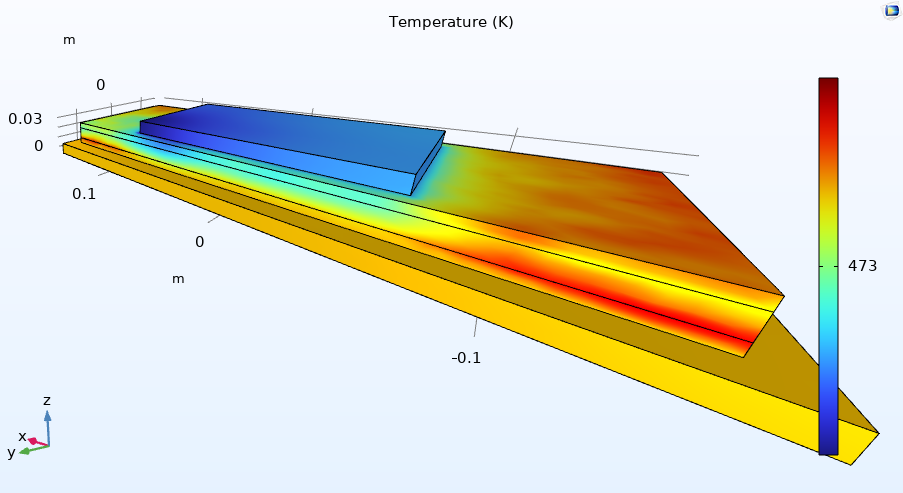
Enlarge image: A 3D COMSOL view of a thin layered stack colored by temperature in kelvin: a cooler blue block sits on top, and the layers beneath grade through green and yellow to a red band, with a color bar marked at 473 K.
Fig. 1 Temperature field from the first model, built in COMSOL Multiphysics in Dec 2025. Its assumptions differ from the 2026 study, so its numbers aren’t comparable.2025 COMSOL Multiphysics model

Overview

Biomass cookstove exhaust carries formaldehyde and acetaldehyde. Aminosilica sorbents can capture them, but a filter only stays useful if its sorbent can be regenerated with heat, which is hard to supply where these stoves are used. With Rishabh Jitender, I modeled whether a thermoelectric generator running off the stove’s own exhaust could provide that heat. Across 1,500 simulated cases, capture stayed near 100%, and none fully regenerated the bed.

Publications

Accepted talk Accepted lightning talk. Slides published on Zenodo.

Thermoelectric-Assisted Regeneration of Aminosilica Sorbents for Cookstove Aldehyde Capture

Samuel Asefa, Rishabh Jitender

MIT Undergraduate Research Technology Conference (URTC) · 2026 · DOI 10.5281/zenodo.23328194

Preprint Working paper, version 1. An earlier model with different assumptions.

Thermoelectric Powered Regeneration of Incomplete Combustion Cooking Pollutant Capturing Amines

Samuel Asefa

Cambridge Open Engage · 1 Dec 2025 · DOI 10.33774/coe-2025-mj9mb

Context

The question

Amine sites on the sorbent bind aldehydes, but capacity is finite. Restoring it takes heat, which is hard to add in low-resource cooking settings. The stove itself is hot, though, so the question was whether its waste heat, harvested through a thermoelectric generator, could heat the sorbent enough to regenerate it without outside power.

Design

The model

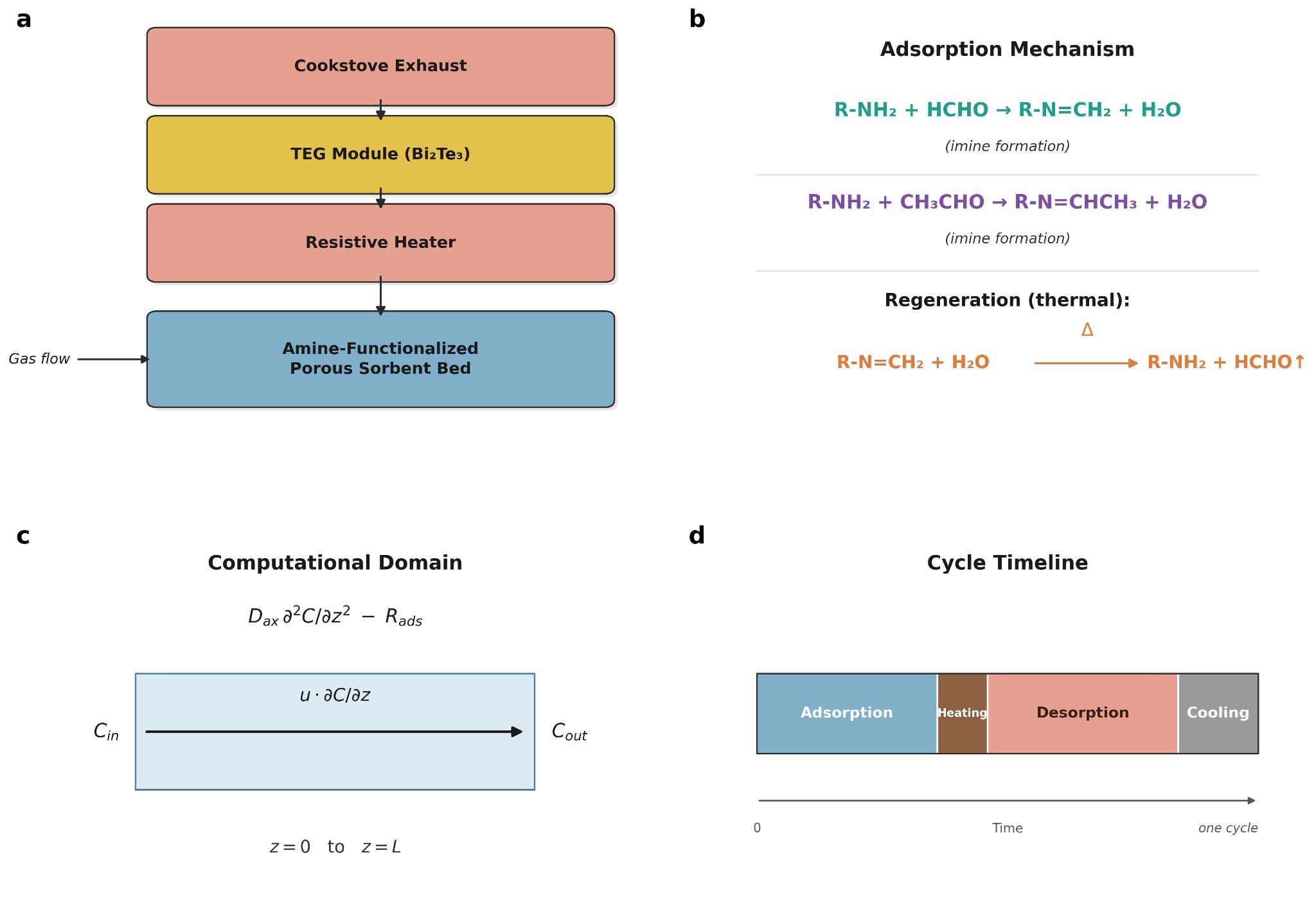
Enlarge figure: Four-panel schematic. (a) Stack: cookstove exhaust, TEG module (Bi2Te3), resistive heater, amine-functionalized porous sorbent bed with gas flow. (b) Imine-formation reactions for formaldehyde and acetaldehyde, and thermal regeneration. (c) One-dimensional computational domain with convection and axial dispersion. (d) Cycle timeline: adsorption, heating, desorption, cooling.
Fig. 2 System concept (a), capture and regeneration chemistry (b), the 1D computational domain (c), and one cycle (d).Figure 1, MIT URTC slides

The filter has three paths. Exhaust passes through a porous aminosilica bed (gas path). Hot exhaust on one side of a TEG and ambient cooling on the other create a temperature difference (thermal path). The TEG’s output drives a resistive heater during regeneration (electrical path). The hard part is that the filter has to capture pollutants and keep pressure drop low while still delivering enough heat to reset the bed.

The model tracks species transport through the packed bed as a 1D axial balance, with kinetic uptake and thermal desorption on the sorbent. It also models the TEG (temperature difference, voltage, and matched-load power) and the pressure drop across the bed. We checked it for grid convergence and solver tolerance, and compared its TEG power and pressure-drop scaling against literature values.

Process

How the question changed

  1. BeniFlow Apr 2024

    An earlier try at the same problem, a device that redirects incomplete-combustion cooking pollutants away from households. It placed 3rd at LaunchSB out of 30+ teams.

  2. First model Dec 2025

    A COMSOL Multiphysics model of TEG-powered regeneration for amine sorbents capturing carbon monoxide and VOCs. It reported up to 2.8 W from a TEG array across a 220 K temperature difference, 87.6% (CO) and 81.3% (VOC) drops in surface concentration within a six-minute regeneration window, and under 4% capacity loss over 50 simulated cycles.

  3. Second model 2026

    Rishabh Jitender and I narrowed the chemistry to formaldehyde and acetaldehyde on aminosilica sorbents, modeled a single TEG module, and ran the model on 1,500 random sets of operating parameters.

Results

What the sweep showed

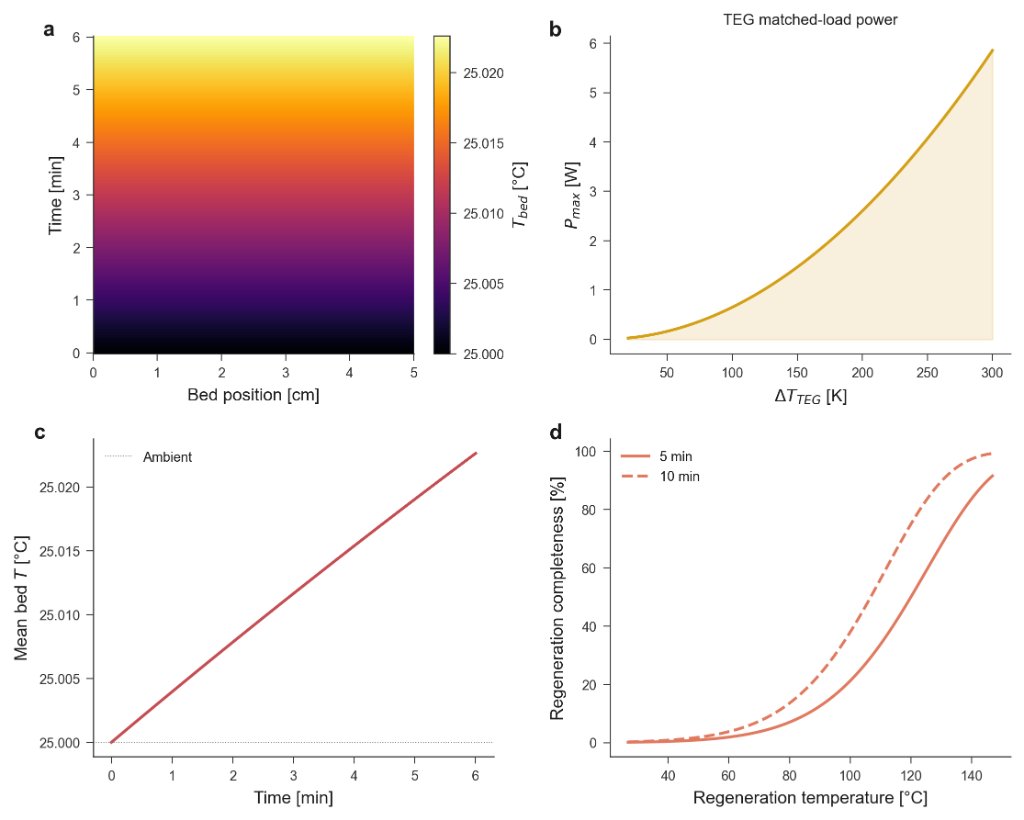
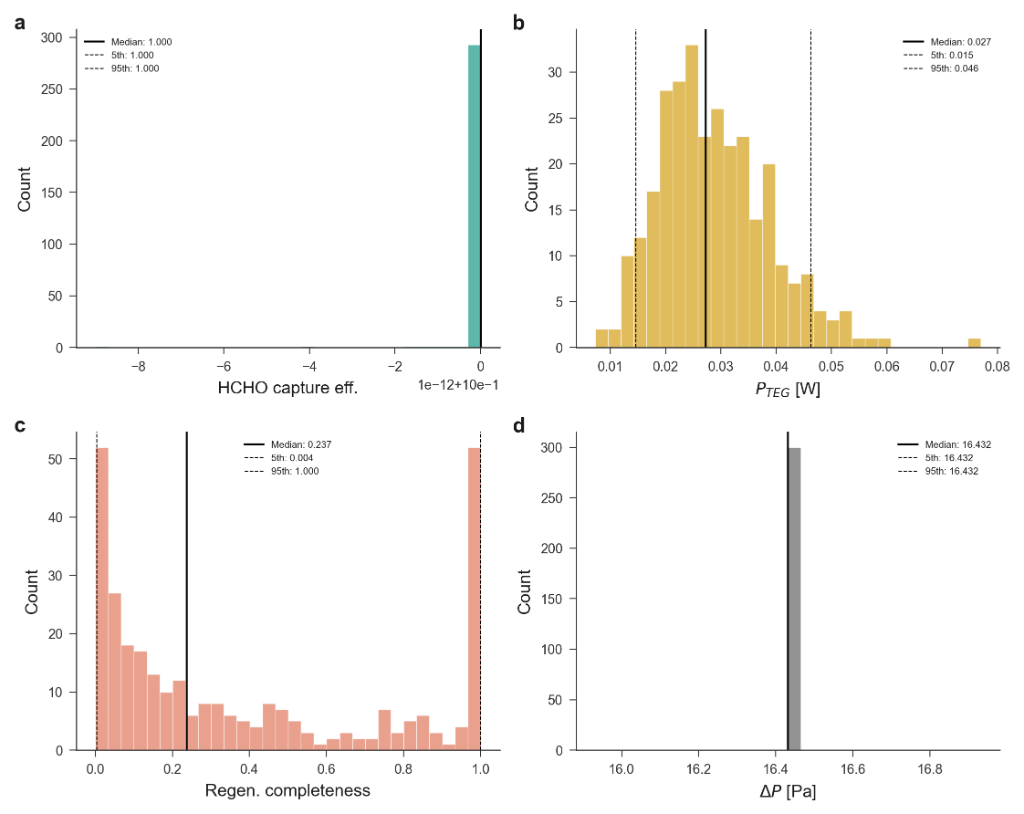
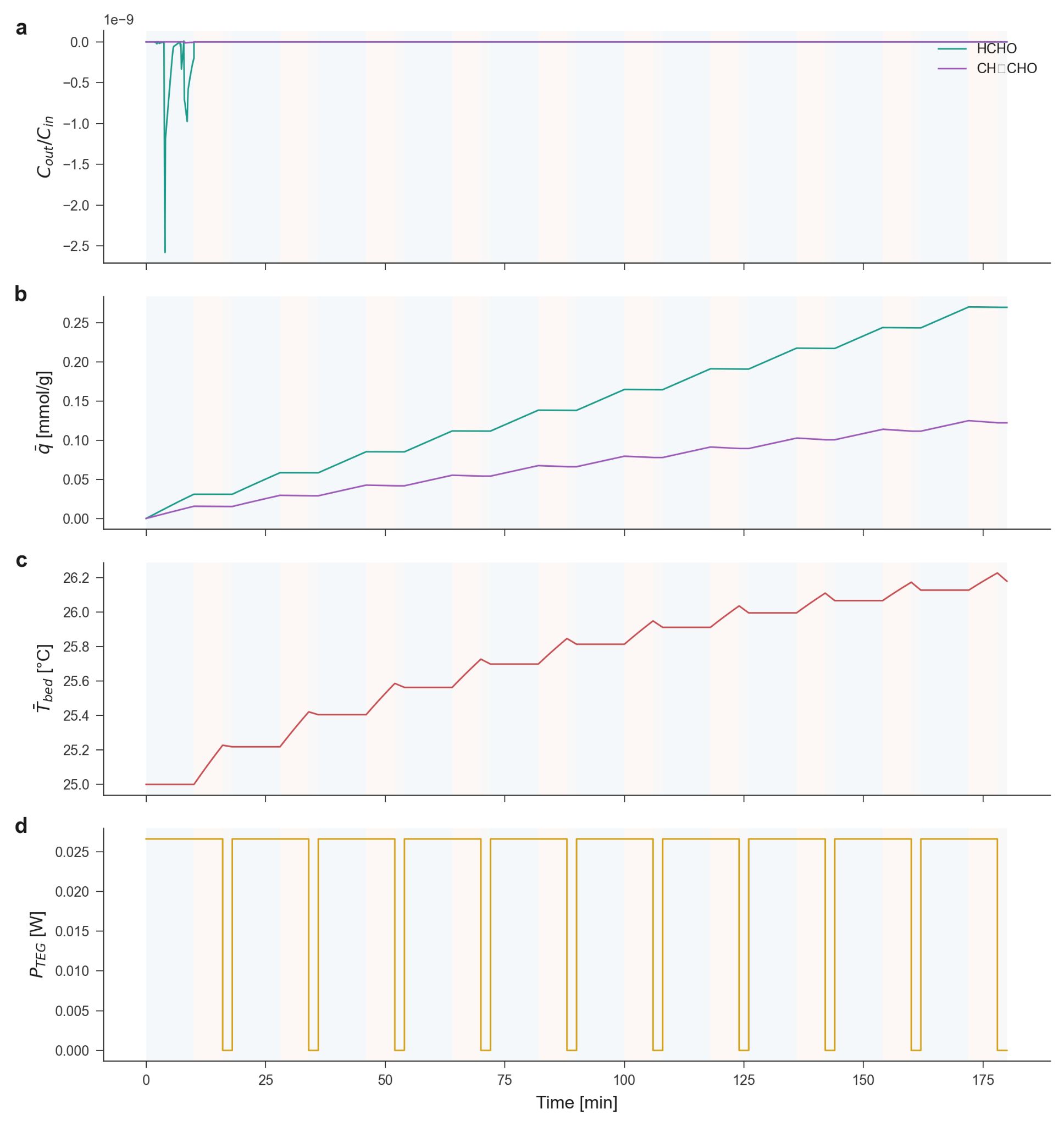
Capture was never the problem. Both aldehydes stayed below breakthrough during the modeled adsorption window in every sampled design, so the bed wasn’t running out of capacity, and regeneration energy ended up being the limit. A single module produced 0.002–0.152 W across the 1,500 cases, and none of them fully regenerated the whole bed.

Enlarge figure: Four panels. (a) Heat map of bed temperature over position and time, ranging only from 25.000 to 25.022 °C. (b) TEG matched-load power rising with temperature difference to about 6 W at 300 K. (c) Mean bed temperature rising linearly by about 0.023 °C over six minutes. (d) Regeneration completeness versus regeneration temperature for 5- and 10-minute windows, approaching 100% only near 140 °C.
Fig. 3 In this run the bed warms by only about 0.02 °C over six minutes (a, c), but regeneration doesn’t get close to complete until about 140 °C (d). Matched-load TEG power grows with the temperature difference across the module (b).Figure 4, MIT URTC slides
Enlarge figure: Four histograms. (a) Formaldehyde capture efficiency, all at 1.000. (b) TEG power in watts, median 0.027, 5th percentile 0.015, 95th percentile 0.046. (c) Regeneration completeness from 0 to 1, median 0.237, with peaks at both ends. (d) Pressure drop, all at 16.432 Pa.
Fig. 4 Across the plotted designs, capture efficiency is 1.000 at the 5th, 50th, and 95th percentiles (a), and median TEG power is 0.027 W (b). Regeneration completeness spreads from 0 to 1, with a median of 0.237 (c).
Reflection

What I’d change next

  1. Heat just the active part of the sorbent instead of treating the whole bed as one thermal mass.
  2. Get a bigger usable temperature difference, with better cold-side heat rejection or a multi-module TEG path.
  3. Cut the pressure drop with lower superficial velocity, larger particles, and higher porosity.

Everything so far is computational. The next step is a small instrumented prototype, so measured temperature, VOC, and pressure-drop data can correct the model.

Resources

Links & Source