Research Preprint

Adaptive Sensor Fusion for Autonomous Robots

A Kalman filter that learns which sensors to trust. In simulation it had 66.2% lower error than a standard EKF under severe degradation.

  • Role: First Author; wrote the simulation, training, and figure code
  • Team: With Rohan Kunala
  • Mentor: Arav Pyati, Cornell University
  • When: May 2026 – present
  • Time: 2–4 hours a week
  • Status: Preprint (working paper)
PythonPyTorchNumPyExtended Kalman filter
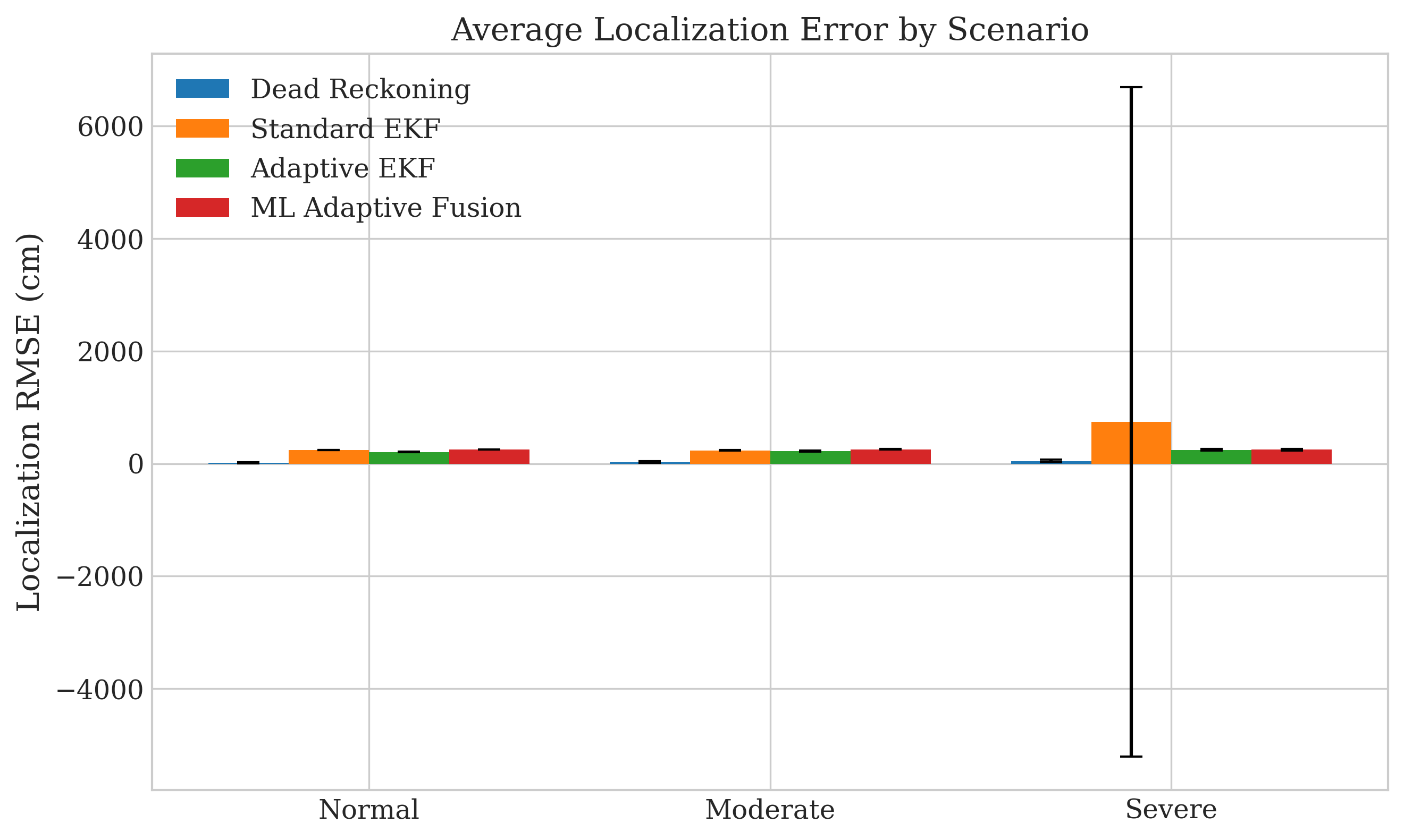
Enlarge figure: Bar chart titled Average Localization Error by Scenario. Localization RMSE in centimeters for dead reckoning, standard EKF, adaptive EKF, and ML adaptive fusion under normal, moderate, and severe conditions. The standard EKF bar rises to about 740 cm under severe conditions with a very large error bar; the others stay near 250 cm or below.
Fig. 1 Average localization RMSE for four estimators at three degradation levels. In the severe case, the standard EKF averaged 743.6 cm and the proposed method 251.7 cm. Error bars are shown as plotted in the preprint.Figure from the preprint

Overview

Low-cost robots localize with sensors that fail in ordinary ways. I paired an Extended Kalman Filter with a small neural network that estimates, at every step, how much to trust each sensor. In 500 simulated Monte Carlo trials under severe sensor degradation, it reduced localization RMSE by 66.2% compared with a standard EKF.

Publications

Preprint Working paper, version 1.

Adaptive Sensor Fusion Using Machine Learning for Robust Localization in Low-Cost Autonomous Robots

Samuel Asefa, Rohan Kunala, Arav Pyati

Cambridge Open Engage · 31 Aug 2026 · DOI 10.33774/coe-2026-n3z2n

Context

The problem

Wheel encoders slip and IMUs drift. Ultrasonic sensors bounce off reflective surfaces, and cameras lose track in poor light or when something blocks the view. A standard EKF weights each sensor with fixed noise covariances, so when a sensor starts failing, the filter keeps trusting it at the old level.

Design

Approach

A lightweight network (ConfidenceNet in the code) predicts a confidence for each of the four sensors, and those confidences scale the measurement covariances before every EKF update. A sensor the network distrusts gets a larger covariance, so its measurements move the estimate less. The network was trained on 100,000 samples from a Python robot simulator.

I compared it against dead reckoning, a conventional EKF, and an innovation-based adaptive EKF, which adjusts covariances from the filter’s own residuals instead of using a learned model.
Results

Results in simulation

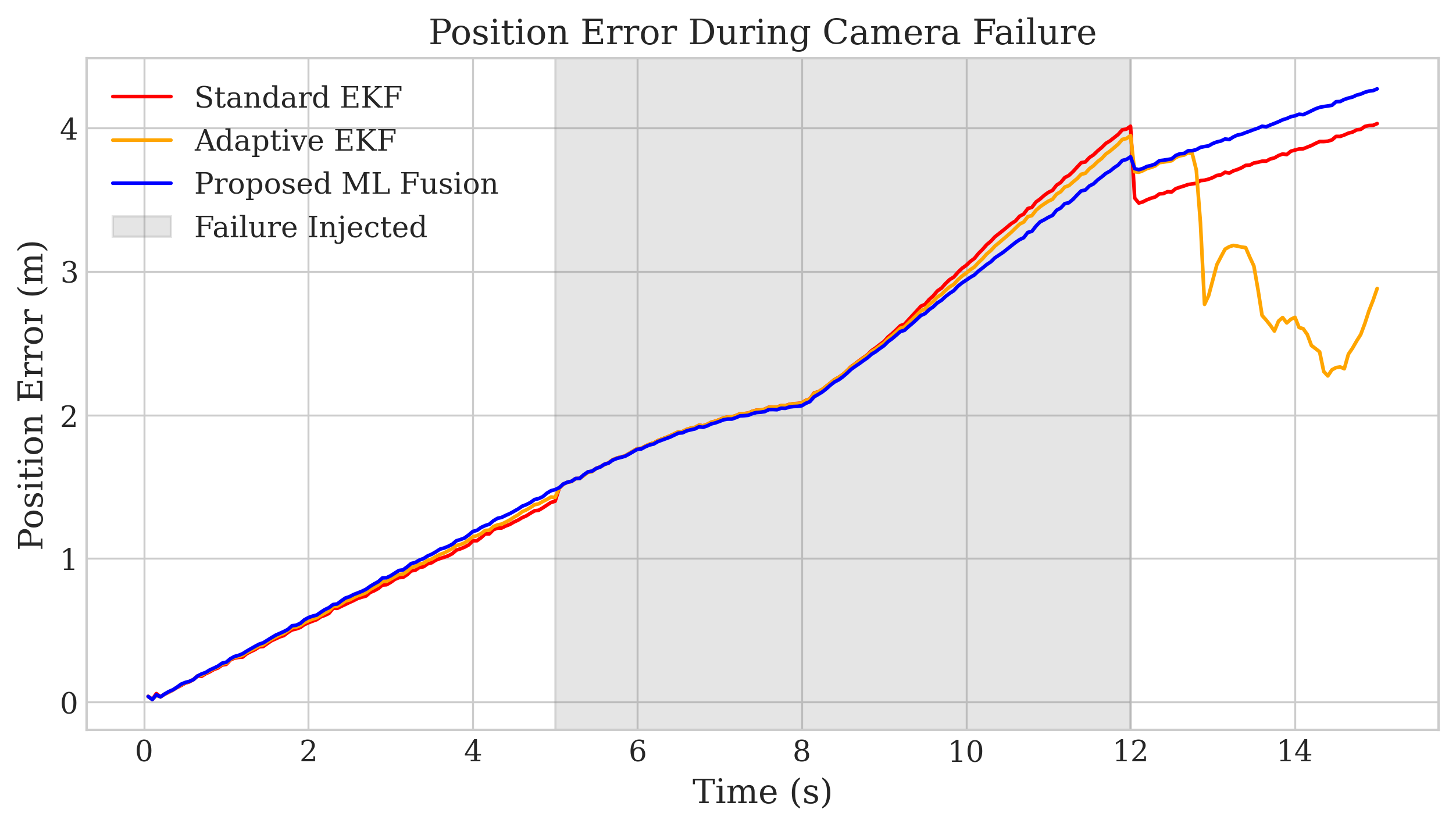
Enlarge figure: Line chart of position error in meters over 15 seconds for standard EKF, adaptive EKF, and proposed ML fusion, with a shaded camera-failure window from 5 to 12 seconds.
Fig. 2 One run with a camera failure injected from 5 to 12 s (shaded). The three filters track closely during the failure, with the proposed fusion slightly lowest at 12 s; after the camera returns, the adaptive EKF recovers furthest.
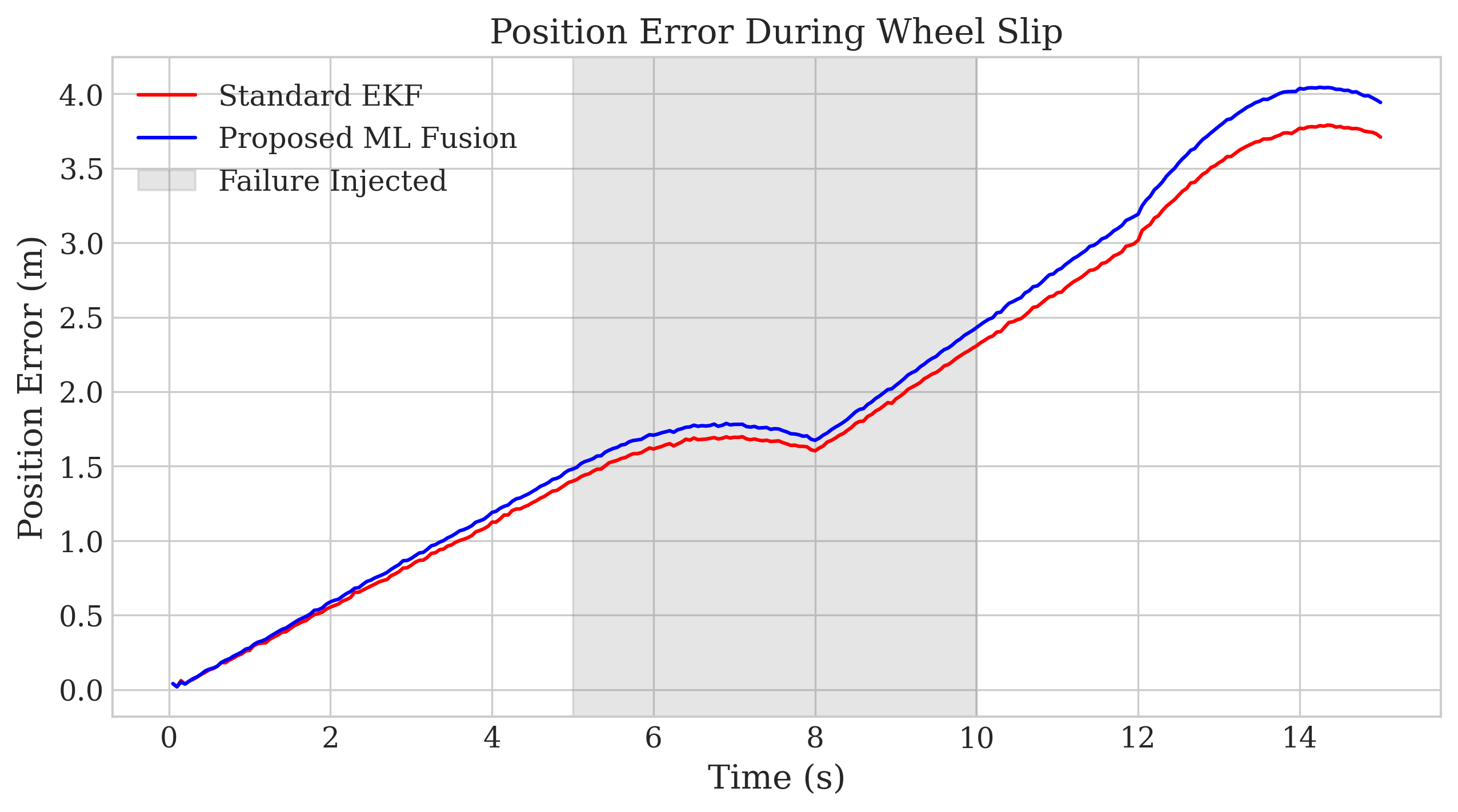
Enlarge figure: Line chart of position error in meters over 15 seconds for standard EKF and proposed ML fusion, with a shaded wheel-slip window from 5 to 10 seconds.
Fig. 3 One run with wheel slip injected from 5 to 10 s. Here the proposed fusion’s error stays slightly above the standard EKF’s throughout.
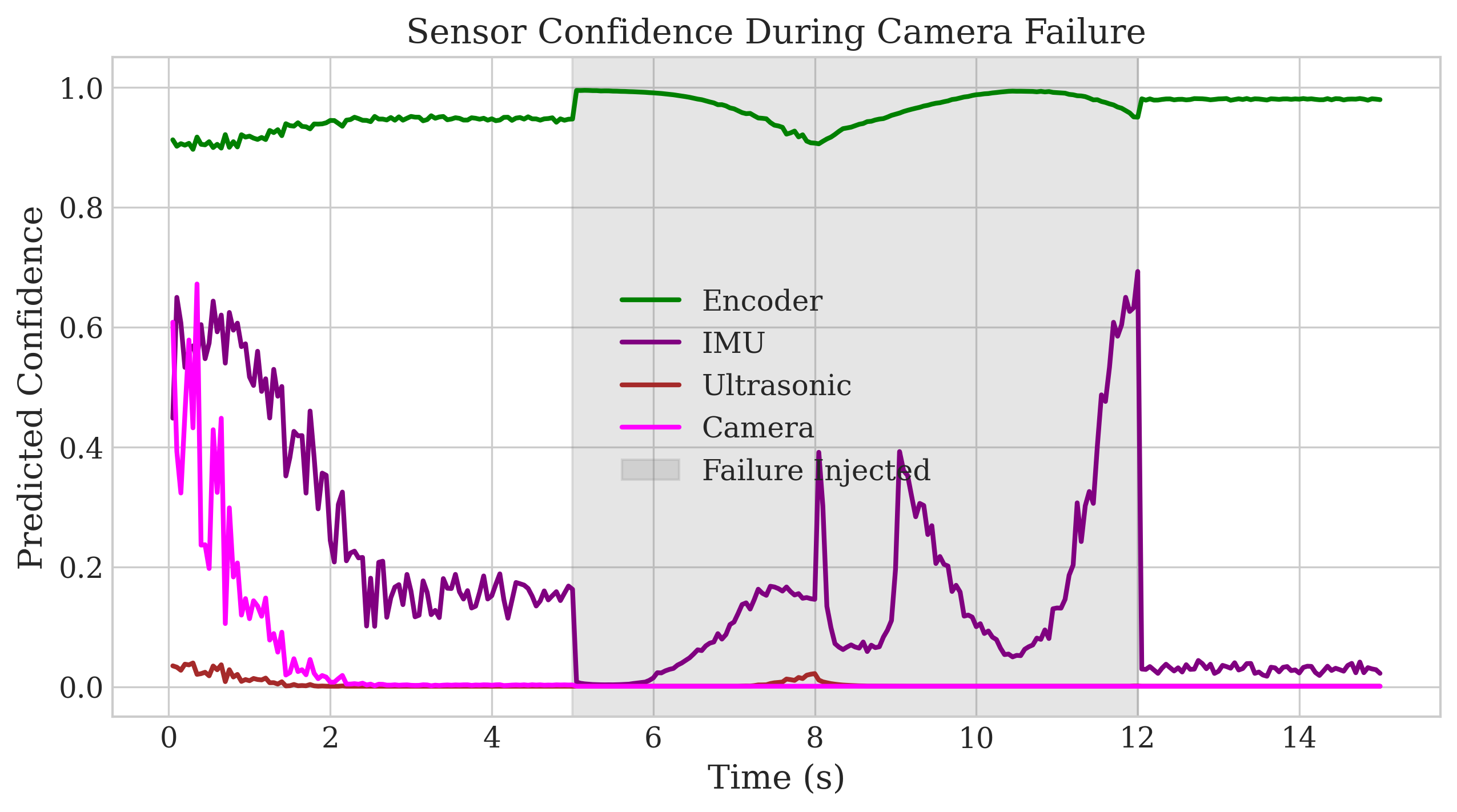
Enlarge figure: Line chart of predicted confidence from 0 to 1 for encoder, IMU, ultrasonic, and camera over 15 seconds, with the failure window shaded.
Fig. 4 The network’s confidence in each sensor during the camera-failure run. Encoder confidence stays near 1; IMU confidence rises and falls inside the window. Camera confidence is already near zero from about 2 s, before the failure begins.
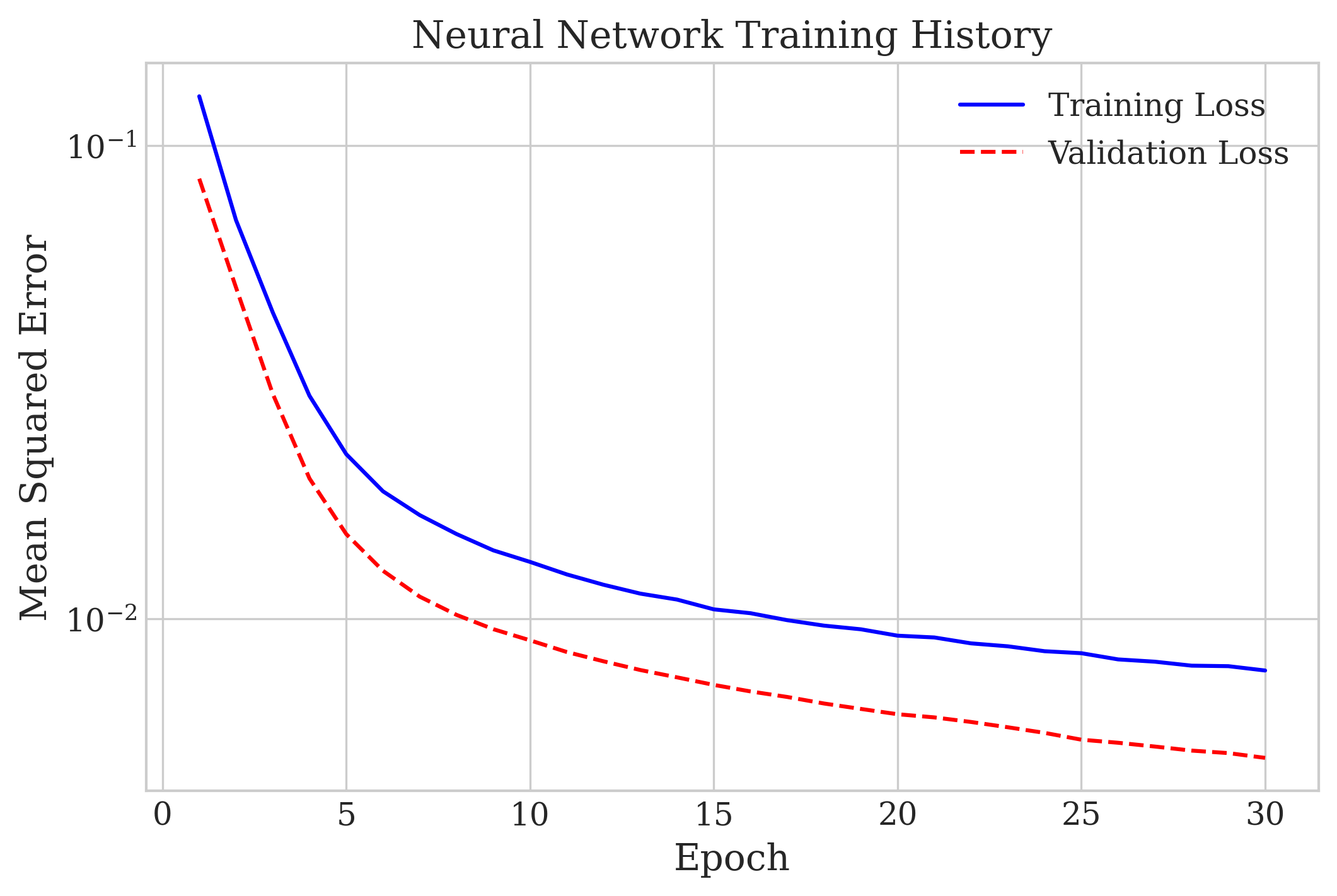
Enlarge figure: Log-scale line chart of training and validation mean squared error over 30 epochs; both fall steeply then flatten.
Fig. 5 Training and validation loss (MSE, log scale) over 30 epochs.
Reflection

Limits

  • Every result is from simulation. The preprint doesn’t report tests on a physical robot.
  • The 66.2% figure compares against a conventional EKF under severe degradation. Against the innovation-based adaptive EKF, the preprint reports no statistically significant difference.
  • Single runs, like the two above, include cases where the learned weighting isn’t the best filter.
Resources

Links & Source