
Research Preprint

Hybrid DeepONet-SHRED-ROM for Flow Field Prediction

A hybrid neural operator that predicts 2D flow around geometries it hasn’t seen before, with a mean relative L₂ error of 0.047.

  • Role: Co-Author (second of three)
  • Team: With Rohan Kunala
  • Mentor: Irenov Joel, The University of Texas at Austin
  • When: May 2026 – present
  • Time: 2–4 hours a week
  • Status: Preprint (working paper, v2)
PythonPyTorchDeepONetLSTM
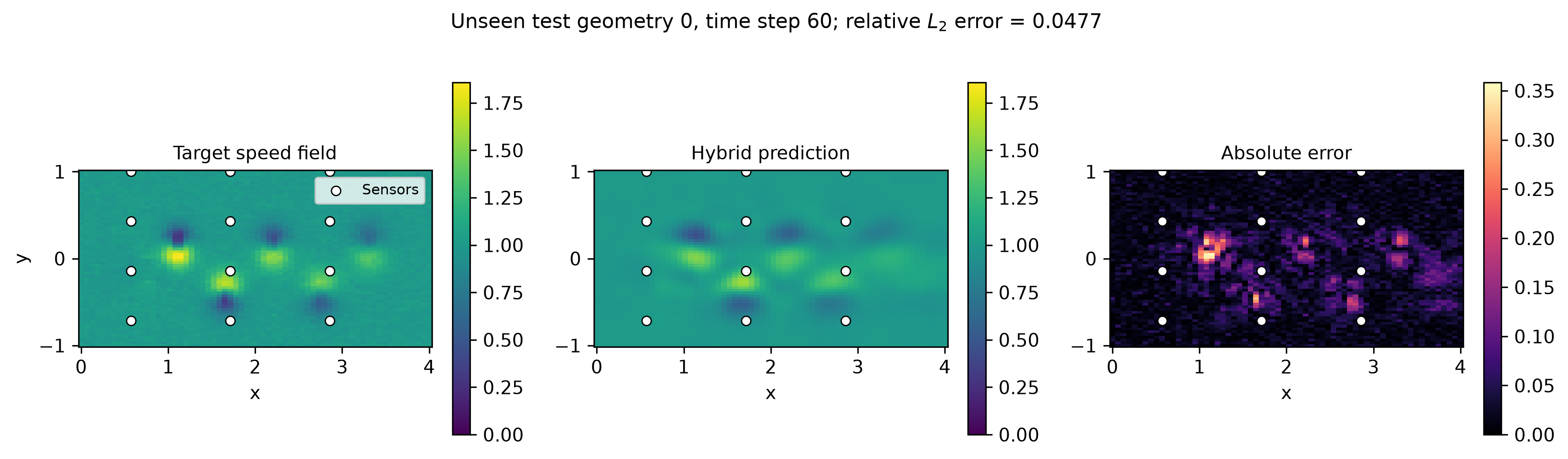
Enlarge figure: Three heat maps side by side for unseen test geometry 0 at time step 60: target speed field, hybrid prediction, and absolute error, with 12 sensor locations marked as white dots. Relative L2 error 0.0477.
Fig. 1 One unseen test geometry at time step 60, showing the target speed field, the model’s prediction, and the absolute error, with the 12 sensors marked. This frame’s relative L₂ error is 0.0477.Figure from the preprint

Overview

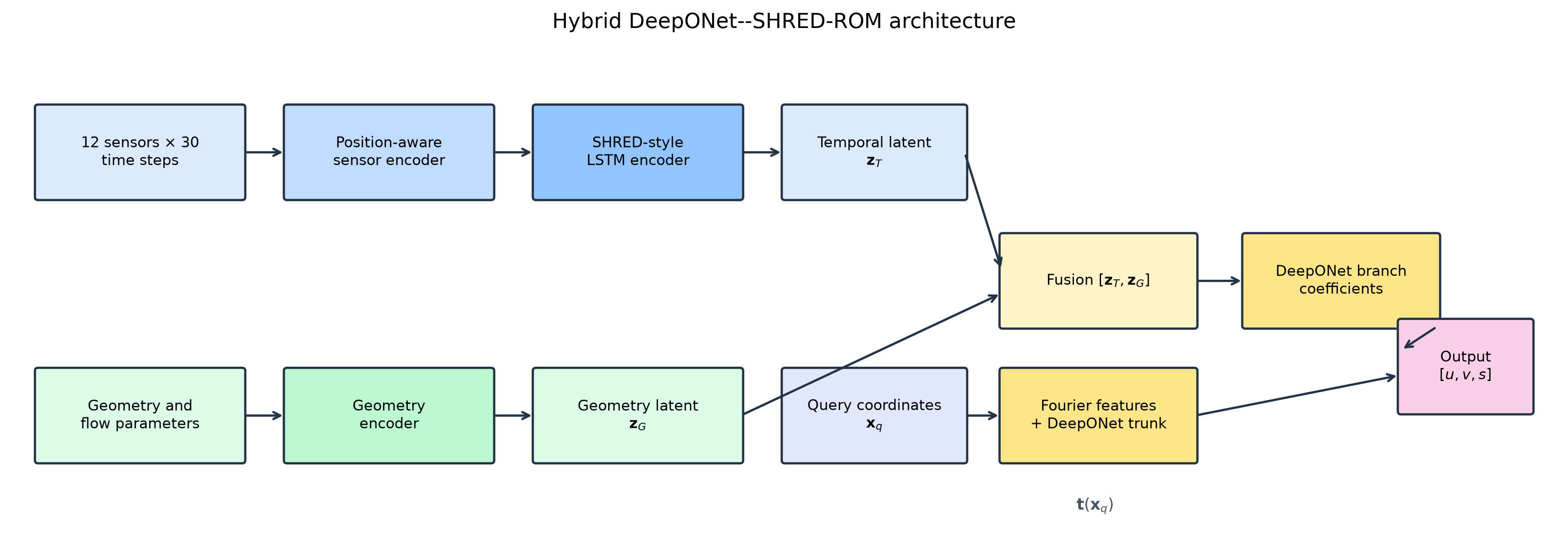
High-fidelity flow simulation is too slow to repeat for every small change in geometry. This model reads a 30-step history from 12 sparse velocity sensors with a SHRED-style LSTM encoder, conditions a DeepONet on the geometry and flow parameters, and predicts velocity and speed anywhere in the domain. On 20 geometry cases it never saw in training, its mean relative L₂ error was 0.047 (median 0.045).

Publications

Preprint Working paper, version 2 (v1 posted 20 Jul 2026).

Hybrid DeepONet–SHRED-ROM Framework for Rapid Prediction of Flow Fields Across Geometry Variations

Rohan Kunala, Samuel Asefa, Irenov Joel

Cambridge Open Engage · 4 Sep 2026 · DOI 10.33774/coe-2026-6h7gp-v2

Design

Architecture

Enlarge figure: Block diagram. Top row: 12 sensors by 30 time steps, position-aware sensor encoder, SHRED-style LSTM encoder, temporal latent z_T. Bottom row: geometry and flow parameters, geometry encoder, geometry latent z_G. Both latents feed a fusion block and DeepONet branch coefficients; query coordinates pass through Fourier features and the DeepONet trunk; outputs are u, v, and s.
Fig. 2 Sensor history and geometry are encoded separately, fused into the DeepONet branch, and evaluated at any query point by the trunk. The model predicts velocity components and speed together, and enforces consistency between predicted speed and the magnitude of the predicted velocity.Figure from the preprint
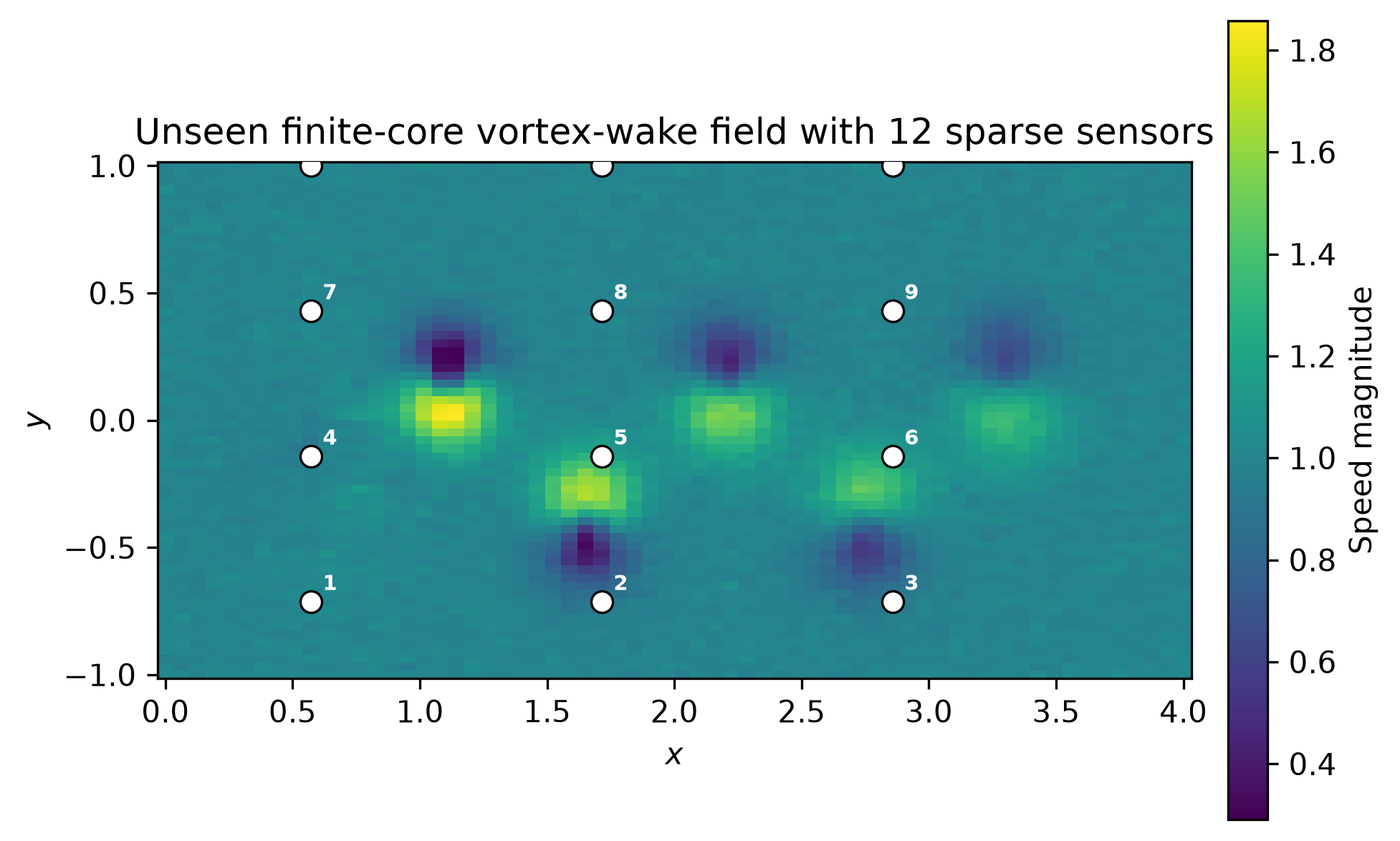
Enlarge figure: Heat map of speed magnitude for an unseen finite-core vortex-wake field over x from 0 to 4 and y from −1 to 1, with 12 numbered sensor positions.
Fig. 3 The 12 sensor positions over an unseen vortex-wake field. The dataset varies obstacle position, size, aspect ratio, shedding frequency, and vortex strength.
Reflection

Limits

  • Tested on a single parameterized vortex-wake dataset, in two dimensions.
Resources

Links & Source